|
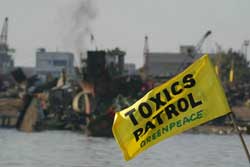
Rainbow Warrior at "Toxic Patrol" in India.
Greenpeace is the voice of 100.000 workers in the worlds shipbreaking yards.
Gulf of Khambat, Arabian Sea, 12/11/03
 The Greenpeace sailing vessel the Rainbow Warrior is currently anchored off the coast of Alang, India. Alang is the site of the world's largest shipbreaking yard. Greenpeace is planning to conduct "toxic patrols" of ships who are here waiting for scrapping. A team of experts will do a survey and take samples to determine what type of toxic materials are on board before the ships are beached and the actual scrapping starts. Shipbreaking is an enormous danger for people and the environment. Greenpeace is the only organization in the world fighting for the people working in this industry and for the environment they live in. This makes Greenpeace the voice of 100.000 people.
On the 14th of October the highest court in India took a very important decision. The resulting Indian Supreme Court Order states that the responsibility for clean scrap (shipbreaking) lies not just with the shipbreakers, but also, and more importantly, with the ship owners. This Court Order says that all ships must be toxic-free before the scrapping actually begins. If the Greenpeace "toxic patrols" show that ships arriving in India for scraping still contain toxic substances, they will demand that the Indian government enforce the Supreme Court Order and take action against the owners of these ships
International Maritime Organization
Greenpeace is also lobbying the Indian government to take a strong position in the IMO with the other shipbreaking countries (Bangladesh, China, Pakistan and Turkey). The IMO is the only party, within the United Nations, which can make international rules for the ship owners. At the moment they have only proposed voluntary guidelines for the shipbreaking industry. Greenpeace believes that only a mandatory international law can effectively regulate the ship owners. At this stage there are many ruses that ship owners can use to subvert these the rules and regulations.
(To know more we invite you to play the
Tricks of the Trade Web Game)
If India is the only country that has strict regulations on shipbreaking then ship owners can easily go to one of the other countries that do not have such strict regulations to scrap their ships.
Scrap yard Alang
The Alang shipbreaking yards started scrapping ships in 1983 and is now the worlds biggest. Alang contains 184 plots and which employ 40.000 workers. Current shipbreaking methods pose a serious danger to both people and the environment. Most of the toxic waste ends up in the ocean. The workers inhale toxic substances, such as asbestos, 24 hours a day: at work and, because they live right next to the yards, at home. They are not provided with any protective clothing or safety equipment nor are they provided with any training on how to deal with toxic materials. There are regular accidents in the yards which often cause the deaths of many people. In the past three months there have been 4 explosions in which 25 people died. On top of all this most workers are paid on average US$1 per day and have no system of workers medical insurance or compensation.
What Greenpeace wants
Greenpeace is not against shipbreaking or the shipbreakers. Greenpeace wants an mandatory international law. This law should require that all ships must have an inventory of all toxic materials on board and where in the ship they are located. A plan must be made to remove all these toxic materials before the ship goes for scrap and before the ship gets scrapped it must be made gas-free to avoid future explosions.
Click here to read the crew weblog
|