|
PESTICIDES ARE POISONS
What are Pesticides?
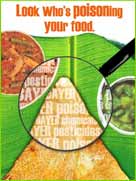
Pesticides are poisonous substances intended to harm or kill living organisms considered as pests. We can be sure that any substance that can kill other living organisms can also harm or kill human beings. Pesticides are variously classified into different categories based on their chemical composition or the purpose for which they have been made or based on their health effects. They could be organophosphates or organochlorines or carbonates or synthetic pyrethroids as per chemical classification. They could be insecticides (intended to kill insects) or herbicides (intended to kill weeds) or rodenticides (intended to kill rats) or fungicides (for killing fungi) and so on. They could be carcinogens (cancer causing) or teratogens (causing defects in the foetus inside the mother’s womb) and so on.
All of us use pesticides in one form or the other: the Baygon spray at home, or All-Out Mosquito repellant or the rat poison, to name only a few. These are household pesticides. There are huge quantities of pesticides being used in other arenas of life: mostly in public healthcare and in agriculture. India is one of the largest producers and users of pesticides in Asia and also exports such poisons to other countries!
Commonly used Pesticides in India
India, unlike many developed countries, produces and uses many deadly pesticides which have been banned years back in those countries. Examples of some such pesticides are endosulfan, methyl parathion, monocrotophos, methamidaphos, chlorpyriphos and so on. Even pesticides like DDT, though they are not supposed to be used for agricultural purposes, find their illegal way into this use in India.
Pesticides and Health
Pesticides are known and established to have adverse effects on human health, in addition to affecting other living organisms. Based on their toxicity levels, the World Health Organisation (WHO) has classified pesticides into various categories: Class I A [Extremely Hazardous], Class I B [Highly Hazardous], Class II [Moderately Hazardous], Class III [Slightly Hazardous] and so on. This classification is misleading because it refers to the immediate or short term effects of pesticides whereas pesticides are also known to cause long term or “chronic” effects. These effects are insidious and people are usually unaware of the links of various illnesses that they face, to the pesticide use around them. Different types of cancers, birth defects, endocrine disruption, immune system disorders, allergies, reproductive system disorders including reduced fertility, learning disabilities, lowered IQ etc., are a few of these effects.
Pesticides and Environment
Pesticides are bio-accumulative (build up in fatty tissues of animals] and bio-magnifying (magnification as one goes up the food chain in nature) in most instances. Usually, pesticide residues can be found in air, water and soil beyond levels considered to be safe. Pesticides are known for causing deaths of other organisms like rare species of eagles, peacocks, fish and other aquatic life, bees, beneficial organisms in farming etc. It is not an exaggeration to say that no segment of population is completely protected against exposure to these toxic chemicals and their potentially serious health effects, especially in countries like ours. You and I are exposed to pesticide residues through water, food, milk, meat etc.
YOU CAN GET RID OF PESTICIDES….
Do we need Pesticides?
Given the fact that pesticides are poisons, do we need them? In agriculture, for example, there are many farmers and non-governmental organizations who have successfully established non-pesticidal management of their crops. A simple principle that farmers have traditionally adopted for this is that of crop diversity. Not opting for ‘mono-cropping’ is a mechanism to control pests and pest resistance to pesticides. There have been studies to show that pesticides have not contributed in any substantial way to increasing or stabilizing yields in agriculture.
In the field of healthcare also, there are alternatives for vector control, especially by using other living organisms. Mosquito breeding can be controlled by breeding other bacteria that feed on mosquito larvae, for instance. For household insecticides, there are simple alternatives centred around principles of good ventilation, cleanliness etc.
Who produces them in India?
Pesticides are produced as “technical grade” material by large companies and then created into “formulations” by smaller companies, usually. These large companies include both Indian companies and multinational companies with their headquarters in the US, Germany, Switzerland etc. Prominent among such companies are Bayer, Monsanto, Syngenta, Dow, DuPont etc. Incidentally, these companies do not hesitate to practise “corporate racism” in our countries: they had stopped producing some of their products in the developed countries but continue to do so in our country, which shows the double standards that they follow. Known Indian companies include Hindustan Insecticides Limited, Rallis, United Phosphorus Ltd, Excel Industries etc.
How can YOU get rid of pesticides?
As the pointed out earlier, pesticides are poisons that harm or kill living organisms, including human beings. Children are especially vulnerable, given their physiology (lower metabolism rates mean lesser capacity to excrete toxics) and behaviour. It is high time that pesticides are understood to be toxic, and measures taken to reduce their use, to protect ourselves and our next generation.
There are established alternatives for almost all uses of pesticides, including ones in your house. These are inexpensive and easily available in most cases. More importantly, alternatives where they do not exist have to be actively encouraged to ensure that pesticides do not cause more harm. You can also ensure that you are not exposed to pesticides through residues by opting for Organic Food. Your city has several such outlets too, where food has been produced in a safe, non-chemical manner.
Encourage your family and neighbors to opt for non-pesticidal approaches. Put pressure on the corporations which make enormous profits at promoting and spreading these poisons around you – get them to stop their production. YOU have the power of changing them by changing YOUR buying habits.
Demand that the government BAN PESTICIDES THAT HAVE BEEN BANNED IN OTHER COUNTRIES. Demand that it enforces its own legislations related to regulation of pesticide use properly. Demand that the government extend its support to promotion of safe alternatives to pesticides.
Click here to view Recent Stories
Click here to view Press Releases
Click here to visit our Document Repository on GE Reports
|