|
Here is Greenpeace India's Best of 2003.
January
,
2003
Arrested in the Netherlands for confronting Dow Chemical: Bhopal survivors continue to call for justice.
 07th January 2003, The Netherlands: 20 activists from Greenpeace, along with Mrs. Rashida Bi, a leader of the Bhopal Gas Peedit Mahila Stationery Karamchari Sangh (BGPMSKS) have been arrested today for confronting Dow Chemical as part of the International Campaign for Justice in Bhopal (ICJB). These members of the ICJB were arrested as they handed over eight barrels of toxic waste from the site of the world's worst industrial disaster in Bhopal, to its rightful owner, Dow Chemical. These barrels were offloaded from the Greenpeace ship 'Arctic Sunrise' and were delivered in person to Mr. Van Harten, Director of Dow Benelux.
February, 2003
Leather Industry Kills Humans Too: Greenpeace & Pasumai Thaayagam take to the ramp at the Leather Fashion Show to demand clean-up of Toxic Tanneries.
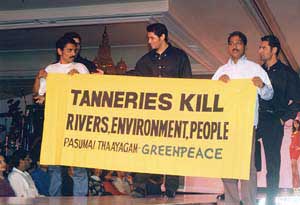 Chennai, 01 Feb 2003: As well-known designers promenaded their leather fantasies at the Leather Fashion Show 2003, activists from Greenpeace and volunteers from Pasumai Thaayagam joined the models on the ramp, to swing the spotlight onto the seamier side of the leather industry. As they walked the ramp, the activists unfurled a six-foot long banner stating ‘Tanneries Kill – Rivers, Environment, People’ and another demanding, ‘Justice for Vellore – Implement Supreme Court Order’.
March:
HLL Hauls 50 Tons of Dumped Mercury to US: Long Road Ahead, warns Greenpeace
Chennai, March 30, 2003: In a move that could have far-reaching implications for multinational corporates who have used India as an easy prey for dumping toxic waste, Hindustan Lever Limited (HLL) has been directed to return Mercury-laden Hazardous Waste to the United States of America and decontaminate the site and its surroundings to global standards. The waste being returned comes from the notorious site of the HLL thermometer factory at Kodaikanal – a site of demonstrations and angry protests from ex-workers’ groups, local communities, the Palni Hills Conservation Council and Greenpeace. The factory has been closed since 2001 following a Greenpeace exposé of hazardous malpractices at the plant. The factory was closed, however, without any steps taken to clean up the site of the high levels of mercury dumped during ‘routine operations’ of HLL.
Pic of clean up of the HLL site
APRIL
Karnataka Government Echoes Central Government’s Lies – Farmers’ Bt Cotton Experiences Misrepresented Yet Again.
 Bangalore, 16 April 2003: Bt Cotton farmers in Karnataka have ample reason to be disgruntled with their government. Although a Congress-led opposition in Andhra Pradesh has demanded and secured compensation for farmers who have incurred losses due to the Bt Cotton fiasco, the Congress government in Karnataka is yet to acknowledge the truth regarding Bt Cotton failure. Instead, in an echo of the lies propounded by the so-called ‘Expert Committee’ of the Genetic Engineering Approval Committee (GEAC), the authorities in Karnataka insist on producing fictitious data that shows Bt Cotton in a positive light.
Field Pic plus archived press release
May,2003
Return to Sender: HLL’s Mercury Waste leaves Indian shores at last
TUTICORIN, 08 May 2003: Heralding a major victory for Greenpeace and local environmental groups, 17 containers carrying 289 tonnes of mercury waste collected from the now-closed thermometer factory of Hindustan Lever Limited in Kodaikanal, Tamil Nadu were shipped to a recycling plant in the United States from Tuticorin port on the wee hours of Thursday.
 Greenpeace and community groups have been vigorously pursuing a "Return to Sender" campaign after they exposed the dumping of mercury waste at a local scrap yard and on the sensitive forest watershed adjoining the thermometer plant. The plant is owned by Hindustan Lever Ltd (HLL), Indian subsidiary of the Anglo-Dutch company, Unilever.
Ship for Scrap to ‘Come Clean’ at Alang: Greenpeace Negotiations Ensure Fewer Deaths At Alang
New Delhi, 27 May, 2003: Just days after another explosion rocked Alang, killing six and injuring several others, a significant breakthrough was achieved by Greenpeace campaigners negotiating with the American/Norwegian shipowner Stolt Nielsen. Stolt Nielsen, which has a history of dumping contaminated ships on Indian beaches, after negotiations with Greenpeace in the Port of Rotterdam, has committed to prevent future pollution and health threats associated with the breaking of ships on the 23rd of May, 2003.
This means that demolition of one of the company’s vessels, the Stolt Sincerity, will be done only when the vessel has been properly decontaminated of hazardous substances, like PCBs, asbestos and oil.
June
,
2003
Shipping company calls for international mandatory regulation to stop deadly effects of toxic ships sent to Asia for scrap
 Geneva, June 10, 2003 – One of the world’s biggest shipping companies, Mediterranean Shipping Company (MSC), conceded today that international mandatory regulations are necessary to protect workers and prevent environmental pollution at Asian shipbreaking yards. MSC also made it clear that it is not willing to step forward and start to clean its ships while the industry as a whole is allowed to continue sending ships contaminated with hazardous substances to Asia.
The call for regulation came as Greenpeace and a delegation of three people from India and Bangladesh involved with shipbreaking yards in India and Bangladesh (1) rang twenty ship bells in front of the company’s headquarters in Geneva, taken from toxic ships from around the world that have recently been scrapped in Asia. The noisy protest was staged to remind MSC and other shipping companies of the impact their toxic ships have on people and the environmental. Only three weeks ago, on May 19th, seven people died at the Alang shipbreaking yard in India because a contaminated ship exploded while it was being scrapped. On 22nd March, a further 10 people died when the Greek oil tanker ‘Amina’ caught fire while being scrapped because it had not been emptied of oil and gas residues prior to arrival at the scrapyard.
Greenpeace Confronts Hindustan Lever Ltd at its Own AGM: Address Your Pending Liabilities in Kodaikanal
Mumbai, 13 June, 2003: Greenpeace activists present at today’s Annual General Body Meeting of Hindustan Lever Limited, Indian unit of the Anglo-Dutch consumer giant Unilever, confronted the company directors of HLL on their own turf. Speaking at the AGM, the activists questioned HLL’s directors on their insensitive refusal to consider the demands of the ex-employees from the now-closed Thermometer factory in Kodaikanal.
About a dozen activists entered the AGM using proxy forms of sympathetic shareholders and raised questions on what the company intends to do to remediate the damage inflicted by the Thermometer factory upon the environment of the area; the health of the ex-workers, and the community at large.
July
Ban Dangerous Pesticides: Greenpeace, farmers, consumers and celebrities
Bangalore, July 4 2003: While five central ministries prepare to file affidavits in response to the Safe Food Public Interest Litigation (PIL) filed in the Supreme Court, Bangalore citizens participated in the first consumer mobilization event organized by Greenpeace as part of their True Food campaign. The campaign calls for safe, true food – food that is free from toxic chemical pesticides and free from Genetically Modified ingredients – for all Indians.

Noted singer and actress Vasundhara Das, and Gerry Martin, the National Geographic naturalist, along with Greenpeace campaigners, addressed a large gathering of fruit and vegetable vendors and consumers at Russel Market this morning. They lent their voices to the campaign, demanding a ban on pesticides and urged consumers to opt for TRUE FOOD.
August,2003
BAYER KEEP YOUR PROMISE, STOP SELLING DEADLY PESTICIDES IN INDIA NOW!
Over 4000 concerned consumers from all over the world have already joined Greenpeace India’s cyber action to condemn Bayer, a German multi-national, on their double standards for reneging on their ‘corporate’ promise to phase out World Health Organisation (WHO) specified highly toxic Class 1 pesticides globally.
September
,
2003
Greenpeace Confronts DBT with Desi Aaloos, Toughens Stance Against GMOs

New Delhi, September 3, 2003: In the light of Dr. Manju Sharma’s self –contradictory statement following Greenpeace’s surprise action at her residence on Tuesday – “…GM potato would be released ‘only’ when the data has been analysed satisfactorily ”, Greenpeace today reiterated its demand to halt all further releases of GM crops, given that bio-safety assessments are never conclusive and cannot establish beyond doubt the safety of any trans-genic crop.
Greenpeace activists surprised Dr. Manju Sharma, Secretary of the Department of Bio-Technology (DBT) with a house-call on Tuesday 2nd September, bearing indigenous potatoes & a banner stating “ GE Food No Solution to Malnutrition.” Dr. Sharma refused to accept the 100 kgs of desi (local) kufri variety of potatoes but did acknowledge that ‘stipulated procedures’ for bio-safety assessments would be fulfilled before the GM potato is considered for approval.
Greenpeace health studies confirm rise in disease and death due to unmitigated industrial pollution at Eloor.
Cochin, September, 10, 2003: Greenpeace today confirmed that the unchecked pollution at Eloor industrial estate near Cochin has resulted in increased rates of disease and death amongst the local population. Diseases like Cancer, congenital birth-defects, Bronchitis, Asthma, Allergic Dermatitis and Stomach Ulcers were found to be extremely common in Eloor according to a Cross sectional Epidemiological study conducted by Greenpeace and medical teams from Occupational Health and Safety Centre, Mumbai
October
,
2003
Supreme Court Ruling will Empower Campaign Against Hazardous Ship-Breaking: Greenpeace
New Delhi, October 16, 2003: The Supreme Court of India has formulated explicit guidelines for the ship-breaking industry at Alang. Greenpeace welcomes this strongly-worded Supreme Court order, and trusts that this will mark a turning point in its campaign against hazardous wastes being dumped by OECD countries on Indian shores, especially at ship-breaking yards.
Based on the recommendations of a high-powered committee (HPC) headed by Prof MGK Menon, a Supreme Court Bench comprising Justice YK Sabharwal and Justice BN Aggarwal has ruled “Ship-breaking operation(s)… cannot be permitted to be continued without strictly adhering to all precautionary principles and taking requisite safeguards…(including) the aspect of the working conditions of the workers.”
www.zerowastekovalam.org launched; Greenpeace and Thanal demand ‘extended producer responsibility’ from tourism garbage manufacturers.
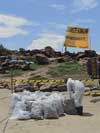
Kovalam, 20 October 2003: On the occasion of the launch of
www.zerowastekovalam.org,
a website and a vision, Greenpeace & Thanal activists along with representatives from the local community, Coast guards and students from local colleges began a clean-up drive at the Kovalam beach today. As a first step they collected over 2000 PET bottles littering the beach to send back to Cola manufacturers demanding that Corporations like Coke and Pepsi should implement extended producer responsibility (1) and stop trashing the planet.
Greenpeace activists arrested for demanding immediate action to stop poisoning of Periyar and her people.
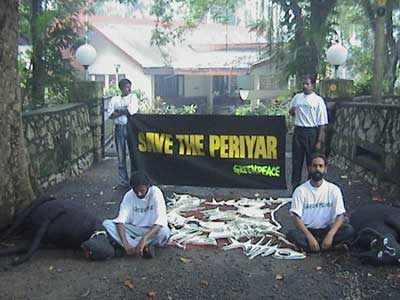 Thiruvananthapuram, October 22, 2003: Police arrested six Greenpeace activists participating in a peaceful protest outside the residence of the Minister of State (Kerala) for Health, Mr. P Sankaran, in Thiruvananthapuram today. The activists had arrived at his residence with replicas of dead fish and buffalo carcasses and a banner that said “Save the Periyar”. Greenpeace activists were demanding that the Minister take immediate action to halt the ongoing tragedy at Eloor.
November
,
2003
Rainbow Warrior to target Corporate Criminals; Greenpeace demands an International Instrument on Corporate Accountability.

Mumbai 7th November 2003: Greenpeace today launched Rainbow Warrior’s Corporate Accountability Tour of India, and announced their intention to intensify campaigns against corporations that flout national and international legislations to commit crimes against humanity and the planet.
British Ships sent to India for Scrap while US Ghost Fleet denied entry to UK

Alang, India 12th November 2003: As the British government continues to refuse permits for scrapping the first of the controversial US navy “ghost ships” which arrive in the UK today, Greenpeace has uncovered British vessels being shipped to India – contravening international agreements and in breach of national laws in India. While controversy rages in Europe over the now infamous “ghost ships”, Britain and other European countries are quietly transporting
their waste ships to developing countries – in breach of the Basel Convention (1)
The Greenpeace flagship Rainbow Warrior has tracked the end-of-life vessel GENOVA BRIDGE to Alang, India – the world’s largest ship breaking yard. Greenpeace demands that the British owner and the British authorities ensure that the toxic materials onboard of this ship will be
removed safely and taken back to England for final disposal. Greenpeace has informed the Minister of Environment and Forests of India, of this gross violation of International conventions and Indian legislation by a UK shipping company.
For the full story on the Rainbow Warrior’s Corporate Accountability Tour of India, click here: Lead to RW subsite.
December, 2003
Greenpeace Releases Right to Know Kit for Citizens, Empowers them to Take Action Against Corporate Crime
December 13th 2003, Cochin: A day after the Greenpeace ship Rainbow Warrior departed from Mumbai, Greenpeace continued its Corporate Accountability campaign from Cochin as scheduled, and released the new Citizen’s Right to Know Kit (CRTK Kit). The CRTK Kit is designed to empower citizens with their Right to Know, and provides practical suggestions on how citizens can wield the power invested in them by the Indian Constitution to protect themselves, their communities and their environment against Corporate Crime.
|